Table of Contents
🎯 Introduction – The Reality Most Aspirants Avoid
Every year, lakhs of candidates dream of joining the armed forces through:
- NDA
- CDS
- AFCAT
- SSB entries
Yet only a small percentage ultimately succeed.
What is surprising is this:
Many aspirants keep failing repeatedly despite years of preparation.
Some fail:
- Written exams
- Screening
- Psychology tests
- Conference stage
- Medicals
After repeated failures, candidates often blame:
- Luck
- Competition
- Coaching institutes
- “Bias in SSB”
But in reality:
Most repeated failures happen because candidates never identify the actual problem.
This article is not meant to discourage anyone.
It is meant to help aspirants understand:
- Why repeated failures happen
- The mindset mistakes candidates make
- What successful candidates do differently
- How to prepare realistically
📘 First Understand This: SSB Is Not a Memory Exam
This is the biggest misunderstanding among aspirants.
Many candidates prepare for SSB like:
- School exams
- UPSC prelims
- Coaching tests
They focus excessively on:
- Memorised answers
- Scripted psychology stories
- Fake body language
- “Recommended candidate behaviour”
But SSB is fundamentally:
A personality and suitability assessment.
The assessors are trying to understand:
- How you think
- How you behave under pressure
- How naturally you function in groups
- Whether officer-like qualities exist consistently
This changes everything.
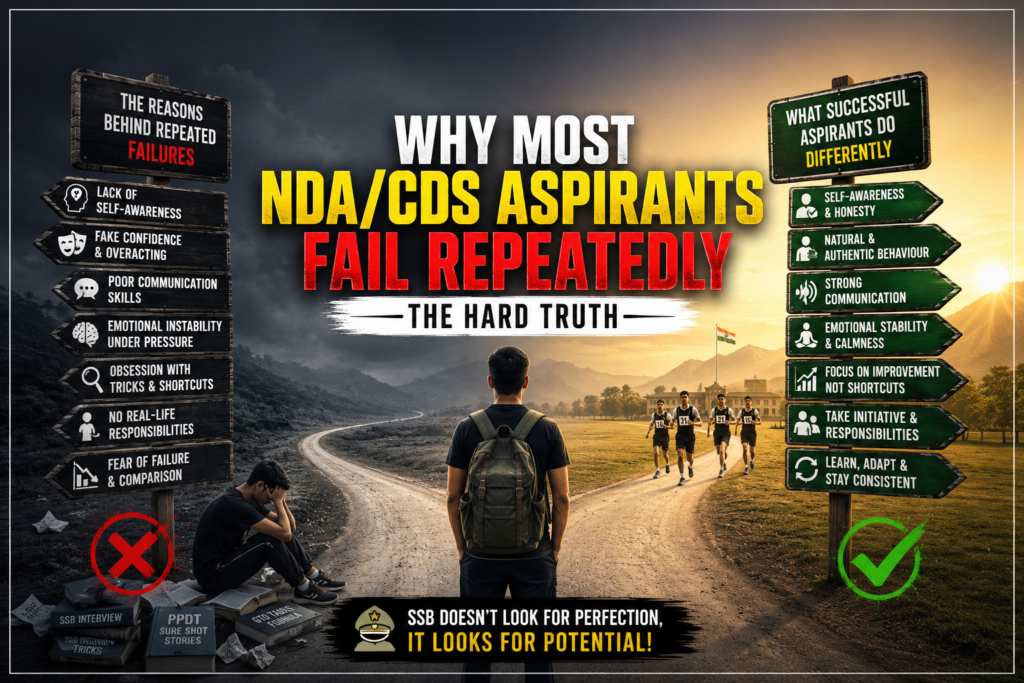
🚨 Major Reasons Why Aspirants Fail Repeatedly
Now let’s discuss the real reasons.
1️⃣ Lack of Self-Awareness
Most aspirants prepare externally but never internally.
They know:
- Current affairs
- GTO tricks
- Psychology formats
But they do not know:
- Their actual strengths
- Their weaknesses
- Their behavioural patterns
SSB heavily rewards:
Personality clarity and self-awareness.
Candidates who lack self-awareness often:
- Give inconsistent responses
- Force artificial behaviour
- Panic under observation
2️⃣ Trying to “Act Like an Officer”
This is one of the biggest reasons for repeated rejection.
Many aspirants behave unnaturally:
- Artificial confidence
- Fake maturity
- Forced leadership
- Over-smart answers
Assessors observe candidates continuously for multiple days.
Artificial behaviour eventually collapses.
🔍 SSB Insight:
The system is designed to detect consistency—not performance acting.
3️⃣ Poor Communication Skills
Many candidates underestimate communication.
Good communication does NOT mean:
- Fancy English
- Fast speaking
- Heavy vocabulary
It means:
- Clarity
- Confidence
- Simplicity
- Relevance
Candidates often fail because:
- Their thoughts lack structure
- They panic while speaking
- They avoid participation
4️⃣ Emotional Instability Under Pressure
SSB intentionally creates:
- Uncertainty
- Group competition
- Time pressure
- Observation stress
Why?
Because armed forces require:
- Emotional stability
- Calmness under pressure
- Decision-making capability
Candidates who:
- Become frustrated easily
- Lose confidence quickly
- React emotionally
often struggle repeatedly.
5️⃣ Obsession With “Tricks” and “Coaching Formulas”
This is becoming increasingly common.
Many aspirants spend more time searching:
- “Secret psychology tricks”
- “How to manipulate SSB”
- “Golden words for PPDT”
- “How to fake OLQs”
Instead of developing actual personality qualities.
Reality:
There are no magical recommendation tricks.
Strong officer-like behaviour cannot be memorised artificially.
6️⃣ Lack of Real-Life Responsibility
This is extremely important.
Recommended candidates often display:
- Initiative
- Accountability
- Practical maturity
Many repeatedly failing candidates:
- Live passively
- Avoid responsibility
- Lack decision-making exposure
Officer-like qualities develop through:
- Real experiences
- Leadership opportunities
- Discipline
- Problem-solving
—not through YouTube shortcuts alone.
7️⃣ Fear of Failure Creates More Failure
After repeated rejection:
- Confidence decreases
- Overthinking increases
- Candidates become hyper-conscious
This creates:
- Artificial behaviour
- Nervousness
- Self-doubt during tasks
Eventually:
The fear of rejection becomes stronger than natural personality expression.
⚖️ What Successful Aspirants Usually Do Differently
Now let’s understand the positive side.
✅ They Stay Natural
Recommended candidates usually:
- Avoid overacting
- Remain genuine
- Behave consistently
✅ They Focus on Improvement, Not Drama
Instead of searching shortcuts, they improve:
- Communication
- Fitness
- Awareness
- Confidence
- Responsibility-taking
✅ They Accept Weaknesses Honestly
Self-awareness creates maturity.
✅ They Develop Leadership in Daily Life
Leadership is not learned only in coaching grounds.
It develops through:
- Initiative
- Teamwork
- Discipline
- Handling responsibilities
✅ They Remain Emotionally Balanced
Even after setbacks, they continue improving calmly.
This resilience itself reflects OLQs.
🧠 The Brutal Truth About SSB
SSB is difficult because:
Personality cannot be memorised overnight.
Written exams test preparation.
SSB tests:
- Behaviour
- Maturity
- Adaptability
- Leadership potential
This is why:
- Coaching helps
but - Coaching alone cannot guarantee recommendation.
🎖️ Officer’s Lens – What Armed Forces Actually Need
The armed forces require officers who can:
- Lead under uncertainty
- Remain calm under stress
- Take responsibility
- Work effectively with teams
Therefore SSB looks beyond:
- Academic marks
- Spoken English
- Social media confidence
It evaluates:
Whether you can become dependable under pressure.
🗣️ How Aspirants Should Actually Prepare
✅ Improve Personality Gradually
Not artificially.
✅ Improve Communication Daily
Simple and confident communication matters most.
✅ Develop Physical & Mental Discipline
Routine builds personality stability.
✅ Take Real Responsibilities
Leadership grows through action.
✅ Stop Comparing Yourself Constantly
Comparison destroys natural confidence.
🧠 Final Takeaway for Aspirants
Repeated failure does NOT always mean:
- Lack of potential
But it may indicate:
- Wrong preparation approach
- Lack of self-awareness
- Artificial behaviour patterns
- Emotional instability
The goal should not be:
“How do I impress assessors?”
The real goal should be:
“How do I genuinely become more officer-like?”
That mindset changes preparation completely.
✍️ Self-Reflection Task
Ask yourself honestly:
- Am I preparing to perform?
OR - Am I preparing to improve myself genuinely?
Your answer may explain your SSB journey more than any coaching advice.