Table of Contents
🎯 Why This Topic Matters for SSB Candidates
The recent tensions surrounding the possible closure of the Strait of Hormuz during the Iran–Israel–US conflict have reminded the world of a crucial geopolitical reality:
A few narrow maritime passages control a massive share of global trade, oil supply, and strategic stability.
These narrow waterways are known as:
- Strategic straits
- Maritime chokepoints
If conflict erupts around them:
- Oil prices rise globally
- Trade slows down
- Supply chains collapse
- Shipping costs increase
- Economies suffer
For countries like India, heavily dependent on maritime trade and imported energy, these straits are critically important.
This topic is highly relevant for:
- Extempore
- Group Discussion
- Personal Interview
- Defence awareness
It tests:
- Strategic understanding
- Global awareness
- National security perspective
- Ability to connect geography with geopolitics
🌐 What Are Maritime Chokepoints?
Maritime chokepoints are narrow sea routes through which a large volume of:
- Global trade
- Oil shipments
- LNG transportation
- Naval movement
passes every day.
Because these routes are narrow:
- They are vulnerable to conflict
- Blockades can disrupt world trade
- Even a single attack can affect the global economy
Modern globalization has made the world deeply dependent on these routes.
📦 Why Are These Straits Important?
Global Maritime Reality:
- Around 80–90% of world trade by volume moves through sea routes
- Nearly one-third of global shipping traffic passes through strategic chokepoints
This means:
Control of sea lanes often means influence over global commerce and energy security.
⚓ Top 05 Critical Straits of the World
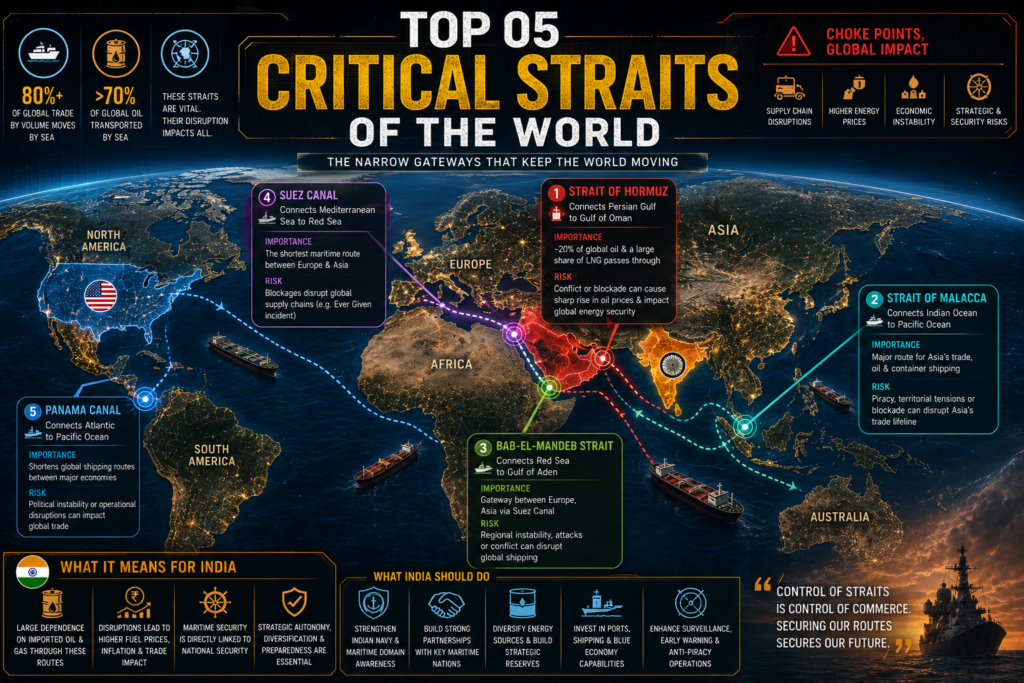
1️⃣ Strait of Hormuz 🇮🇷🇴🇲
📍 Location
Connects:
- Persian Gulf
to - Gulf of Oman & Arabian Sea
Located between:
- Iran
- Oman
📊 Global Importance
Approximate global significance:
- Handles nearly 20–25% of global oil trade
- Around 20% of global LNG trade
- One of the world’s busiest energy corridors
🛢️ Why It Matters
Major oil exporters using this route:
- Saudi Arabia
- UAE
- Kuwait
- Iraq
- Qatar
Major importers affected:
- India
- China
- Japan
- South Korea
India imports a significant portion of its crude oil through this route.
⚠️ What Happens If Conflict Erupts?
Possible consequences:
- Sharp rise in global oil prices
- Inflation worldwide
- Shipping insurance costs increase
- Economic slowdown in importing countries
For India:
- Fuel prices rise
- Trade deficit worsens
- Inflation pressure increases
🔍 SSB Insight:
Energy security is directly linked with national security.
2️⃣ Strait of Malacca 🇸🇬🇲🇾🇮🇩
📍 Location
Connects:
- Indian Ocean
to - Pacific Ocean
Between:
- Malaysia
- Indonesia
- Singapore
📊 Global Importance
Approximate global significance:
- Carries nearly 25–30% of global trade
- Handles around 30% of global maritime commerce
- One of Asia’s busiest shipping lanes
🚢 Why It Matters
This strait is critical for:
- Asian manufacturing economies
- Oil transport to East Asia
- Container shipping routes
Countries heavily dependent:
- China
- Japan
- South Korea
- India
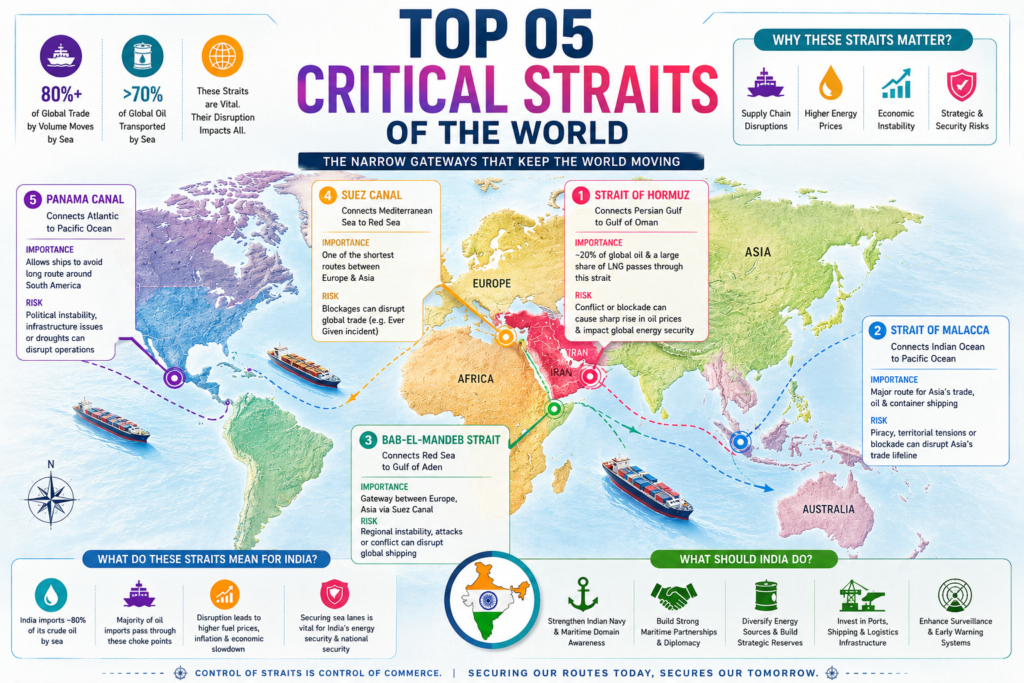
⚠️ Conflict or Blockade Risks
Risks include:
- Naval tensions
- Piracy
- Strategic rivalry
- Blockades during war
If disrupted:
- Supply chains slow globally
- Shipping routes become longer and expensive
- Asian economies face major disruption
🔍 SSB Insight:
The Malacca Strait highlights how economic power depends on maritime security.
3️⃣ Bab-el-Mandeb Strait 🇾🇪🇩🇯
📍 Location
Connects:
- Red Sea
to - Gulf of Aden
Near:
- Yemen
- Djibouti
- Horn of Africa
📊 Global Importance
Approximate global significance:
- Handles around 10–12% of global trade
- Major route for Europe–Asia shipping
- Important for oil and container traffic via Suez Canal
🌍 Why It Matters
This route links:
- Europe
- Asia
through the Red Sea and Suez Canal system.
Recent attacks in the Red Sea have shown its vulnerability.
⚠️ What Happens During Conflict?
Potential impacts:
- Delays in Europe–Asia trade
- Increased shipping costs
- Diversion around Africa increases transit time
This directly affects:
- Global supply chains
- Fuel prices
- Trade efficiency
4️⃣ Suez Canal 🇪🇬
📍 Location
Located in Egypt.
Connects:
- Mediterranean Sea
to - Red Sea
📊 Global Importance
Approximate global significance:
- Handles around 12–15% of global trade
- Nearly 30% of global container traffic
- Major Europe–Asia shipping route
🚢 Why It Matters
This canal significantly reduces travel time between:
- Europe and Asia
Without Suez:
- Ships must travel around Africa
- Costs and delivery times increase massively
⚠️ Lessons from the Ever Given Incident
In 2021, blockage of the Suez Canal by the Ever Given ship demonstrated:
- How one disruption can affect the global economy instantly
Effects included:
- Delayed cargo movement
- Supply chain disruptions
- Billions in trade losses
🔍 SSB Insight:
Modern economies are highly interconnected and vulnerable.
5️⃣ Panama Canal 🇵🇦
📍 Location
Connects:
- Atlantic Ocean
to - Pacific Ocean
Located in:
- Panama
📊 Global Importance
Approximate global significance:
- Handles around 5–6% of global maritime trade
- Critical for Americas-related shipping routes
🌎 Why It Matters
The canal allows ships to avoid:
- Long voyages around South America
It is strategically important for:
- Global container shipping
- US trade
- Energy transportation
⚠️ Risks During Crisis
Potential disruptions:
- Political instability
- Climate-related droughts
- Infrastructure problems
Recent water shortages already affected canal operations.
📈 Combined Importance of These Straits
Together, these maritime chokepoints handle:
- Majority of global energy transportation
- Huge percentage of world container trade
- Critical military and naval movement
This shows:
Globalisation depends heavily on secure maritime routes.
🇮🇳 Why These Straits Matter for India
India depends heavily on:
- Imported crude oil
- Maritime trade
- Sea-based supply chains
A disruption in these straits can affect:
- Fuel prices
- Inflation
- Trade balance
- Economic growth
- National security
India’s strategic location in the Indian Ocean also gives it major maritime importance.
📚 Lessons for India
1️⃣ Strengthen Maritime Security
India must continue strengthening:
- Indian Navy
- Maritime surveillance
- Coastal defence
- Anti-piracy capability
Sea lanes are strategic assets.
2️⃣ Diversify Energy Sources
India should:
- Reduce excessive dependence on Gulf oil
- Expand renewable energy
- Build green hydrogen capability
- Diversify suppliers
3️⃣ Build Strategic Petroleum Reserves
Energy reserves help nations survive temporary disruptions.
Preparedness reduces vulnerability.
4️⃣ Develop Strong Maritime Partnerships
India should deepen cooperation with:
- ASEAN nations
- Gulf countries
- Indian Ocean partners
- QUAD nations
Diplomacy supports maritime security.
5️⃣ Invest in Indigenous Shipping & Port Infrastructure
India should strengthen:
- Sagarmala projects
- Port modernization
- Merchant shipping
- Blue economy initiatives
⚖️ A Strategic Perspective
These straits show that:
Geography continues to shape global politics and economics.
Modern conflicts are no longer limited to land battles.
Control over:
- Sea routes
- Energy corridors
- Maritime chokepoints
can influence:
- Trade
- Energy prices
- Strategic power balance
🎯 SSB Reality:
Future officers must understand:
- Geography
- Economics
- Strategy
- Maritime security
as interconnected dimensions of national security.
🗣️ How to Speak on This Topic in Extempore (60–90 Seconds)
Suggested Structure:
- Define strategic straits
- Mention top chokepoints
- Explain their trade importance
- Discuss risks during conflicts
- Explain India’s concerns and solutions
Sample Flow:
“Strategic straits are narrow maritime routes through which major global trade and energy supplies pass.
Important chokepoints include the Strait of Hormuz, Malacca Strait, and Suez Canal.
These routes handle a huge percentage of global oil and container trade, making them economically critical.
Conflicts near these straits can disrupt supply chains and increase fuel prices worldwide.
For India, strengthening maritime security and diversifying energy sources are extremely important.”
🎖️ Officer’s Lens: How an Armed Forces Officer Should View This
An officer must understand:
- Maritime security is economic security
- Trade routes influence national stability
- Energy supply impacts military preparedness
Modern warfare increasingly includes:
- Economic pressure
- Naval dominance
- Maritime control
Protecting strategic routes is now a critical part of national defence.
🧠 Final Takeaway for SSB Aspirants
This topic teaches a major strategic lesson:
A narrow sea passage can influence the global economy.
For India:
- Maritime awareness is essential
- Energy security is strategic security
- Preparedness matters before crises emerge
If you can discuss this topic:
- Calmly
- Strategically
- With national-interest perspective
—you naturally demonstrate mature officer-like thinking.
✍️ Self-Practice Task
- Speak on this topic for 90 seconds
- Focus on:
- Strategic understanding
- Simplicity
- National security perspective
Remember:
Control of maritime routes often shapes the balance of global power.
Master Your OLQs (Special Offer)
Success in GTO is 100% dependent on your Officer-Like Qualities. If you want to internalize these traits naturally, my Ebook “OLQs – How to Prepare for OLQs Without Coaching” provides the exact roadmap used by recommended candidates.
Grab your copy today for just Rs. 499/- and start your journey toward the uniform. Buy Now.