Table of Contents
🎯 Why This Topic Matters for SSB Candidates
The ongoing tensions involving Iran, Israel, and the United States are not just regional events—they have major implications for:
- Global stability
- Energy security
- International trade
- Defence preparedness
- India’s foreign policy
This is an extremely relevant topic for:
- Extempore
- Group Discussion
- Personal Interview
Many candidates make mistakes by:
- Taking emotional or ideological sides
- Turning the discussion into religious or political debate
- Ignoring India’s national interests
In SSB, assessors expect candidates to think like future officers:
- Calmly
- Strategically
- Nationally
This topic tests:
- Geopolitical awareness
- Strategic thinking
- Understanding of India’s vulnerabilities
- Ability to analyse lessons for India
📘 Understanding the Conflict
The Middle East has long remained a region of geopolitical tension.
The current crisis involves:
- 🇮🇷 Iran
- 🇮🇱 Israel
- 🇺🇸 United States
The conflict has escalated due to:
- Iranian nuclear concerns
- Israeli security interests
- US involvement in regional security and alliances
- Proxy conflicts across the Middle East
Recent tensions have included:
- Missile and drone attacks
- Airstrikes on strategic infrastructure
- Naval tensions near the Strait of Hormuz
- Threats to global energy supply chains
🛢️ Why This Conflict Matters to India
India may not be directly involved militarily, but the consequences can strongly affect the country.
Key Reasons:
- India imports a large portion of its crude oil
- Much of India’s energy passes through the Middle East
- Millions of Indians work in Gulf nations
- India has strategic relations with:
- Israel
- Iran
- Gulf countries
- United States
This creates a complex diplomatic and economic challenge.
⚡ Energy Security Challenges for India
This is the most important dimension of the topic.
1. Dependence on Imported Oil
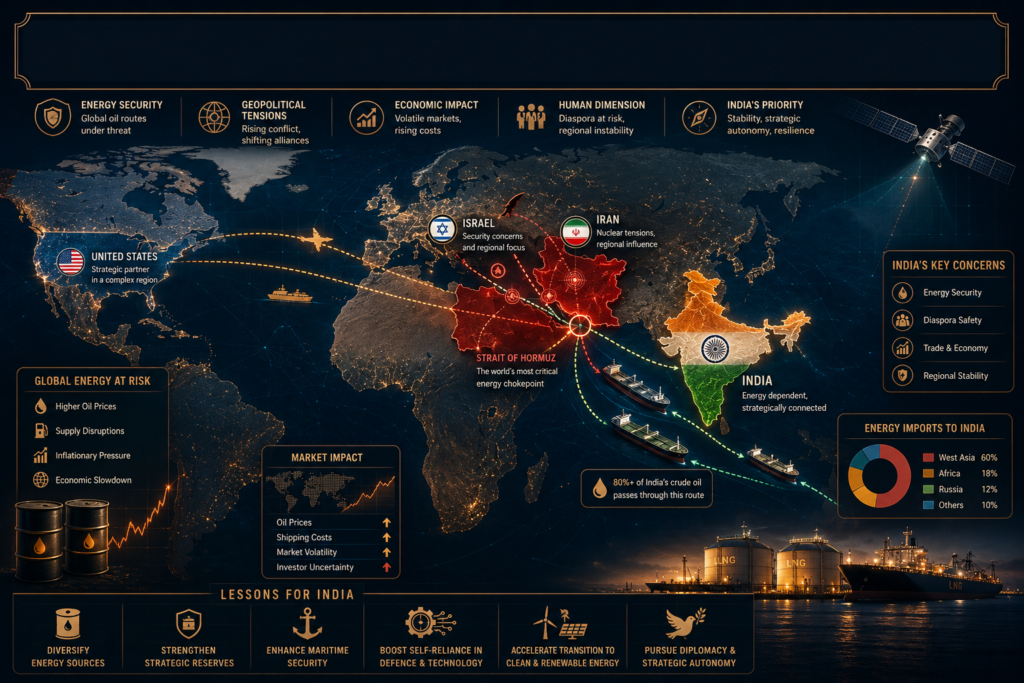
India imports more than 80% of its crude oil requirements.
A major portion comes from the Gulf region.
Any conflict in the Middle East can:
- Increase oil prices
- Disrupt supply chains
- Create inflationary pressure
2. Importance of the Strait of Hormuz
The Strait of Hormuz is one of the world’s most important energy chokepoints.
A large amount of:
- Crude oil
- LNG (Liquefied Natural Gas)
passes through this route.
If tensions disrupt this route:
- Fuel prices in India may rise sharply
- Shipping and insurance costs increase
- Energy security becomes vulnerable
3. Impact on Indian Economy
Higher oil prices affect:
- Transport costs
- Inflation
- Manufacturing
- Fertilizer prices
- Aviation sector
This can slow economic growth.
4. Threat to Indian Diaspora
Millions of Indians live and work in Gulf countries.
Conflict can:
- Threaten their safety
- Affect remittances
- Create evacuation challenges
🔍 SSB Insight:
A good candidate always considers the human and economic dimension, not just military conflict.
🇮🇳 India’s Diplomatic Challenge
India faces a difficult balancing act.
Relations with Israel
India shares strong ties with Israel in:
- Defence technology
- Intelligence cooperation
- Agriculture and innovation
Relations with Iran
Iran remains important for:
- Energy security
- Chabahar Port connectivity
- Regional access to Central Asia
Relations with the US
India also maintains strategic ties with the United States.
Therefore:
India cannot afford extreme positioning.
India’s approach has largely focused on:
- Strategic autonomy
- Diplomacy
- De-escalation
- National interest protection
🔍 SSB Insight:
This reflects mature foreign policy thinking.
📚 Key Lessons for India
This is the most important analytical part of the topic.
Lesson 1: Energy Diversification Is Essential
India cannot remain excessively dependent on one region.
India must:
- Diversify oil suppliers
- Expand renewable energy
- Increase domestic production
- Invest in green hydrogen and solar energy
Lesson 2: Strategic Petroleum Reserves Matter
Strategic oil reserves help during crises.
India has already started strengthening reserves, but future conflicts show:
More reserve capacity is necessary.
Lesson 3: Maritime Security Is Critical
Sea routes are becoming strategic battle zones.
India must strengthen:
- Indian Navy capabilities
- Maritime surveillance
- Protection of trade routes
The Indian Ocean is becoming increasingly important.
Lesson 4: Self-Reliance in Defence and Technology
Modern conflicts show the importance of:
- Drones
- Missile defence systems
- Cyber warfare
- Indigenous defence manufacturing
India must continue strengthening:
- Atmanirbhar Bharat in defence
- Indigenous technology development
Lesson 5: Preparedness for Hybrid Warfare
Modern wars are not fought only with tanks and soldiers.
Conflicts now include:
- Cyber attacks
- Information warfare
- Economic pressure
- Drone warfare
India must prepare for:
- Multi-domain warfare
- Civil defence awareness
- Information resilience
⚖️ A Balanced Perspective
India should avoid emotional or ideological responses.
Instead, India’s priorities should be:
- Peace and stability
- Protection of national interests
- Energy security
- Safety of Indian citizens abroad
- Strategic autonomy
🎯 SSB Reality:
An officer thinks in terms of:
- National interest
- Stability
- Long-term consequences
—not emotions.
🗣️ How to Speak on This Topic in Extempore (60–90 Seconds)
Use a structured flow:
- Briefly explain the conflict
- Explain why it matters to India
- Mention energy security concerns
- Discuss lessons for India
- Give balanced conclusion
Sample Flow (Outline):
“The ongoing Iran–US–Israel conflict has major geopolitical and economic implications.
For India, the biggest concern is energy security because a large portion of oil imports pass through the Strait of Hormuz.
Rising tensions can increase oil prices, inflation, and shipping risks.
The conflict also highlights the importance of energy diversification, strategic reserves, and maritime security for India.
In my opinion, India should continue following a balanced and diplomacy-focused approach while strengthening long-term strategic preparedness.”
👥 Group Discussion & Interview Pointers
In Group Discussion:
Avoid:
- Religious arguments
- Emotional statements
- Taking extreme sides
Instead focus on:
- India’s interests
- Energy security
- Strategic stability
Use phrases like:
- “From India’s strategic perspective…”
- “Another important implication is…”
In Interview:
You may be asked:
- “Should India take sides?”
- “How does this affect India economically?”
- “What lessons should India learn?”
Answer with:
- Calm analysis
- Balanced reasoning
- National-interest approach
🎖️ Officer’s Lens: How an Armed Forces Officer Should View This
An officer must:
- Understand geopolitical realities
- Think strategically
- Remain calm during uncertainty
- Prioritise national interest
From an officer’s perspective:
- Energy security is national security
- Maritime routes are strategic assets
- Preparedness matters more than reaction
Modern conflicts teach that:
Nations must build resilience before crises occur.
🧠 Final Takeaway for SSB Aspirants
This topic is not about choosing sides.
It is about understanding:
- Geopolitics
- Energy security
- Strategic preparedness
- National interest
If you can discuss this topic:
- Calmly
- Objectively
- Strategically
—you naturally demonstrate mature officer-like thinking.
✍️ Self-Practice Task
- Speak on this topic for 90 seconds
- Focus on:
- Clarity
- Structure
- National-interest perspective
Avoid emotional language.
Think like a future military leader.
Master Your OLQs (Special Offer)
Success in GTO is 100% dependent on your Officer-Like Qualities. If you want to internalize these traits naturally, my Ebook “OLQs – How to Prepare for OLQs Without Coaching” provides the exact roadmap used by recommended candidates.
Grab your copy today for just Rs. 499/- and start your journey toward the uniform. Buy Now.