Table of Contents
🎯 Why This Topic Matters for SSB Candidates
“One Nation One Election” is not merely a political discussion topic—it is a thinking and personality assessment tool in the SSB.
Many candidates struggle with such topics not due to lack of information, but because they:
- Take extreme or emotional positions
- Copy media opinions
- Sound biased or rehearsed
In SSB extempore, group discussion, or interview, assessors are not evaluating your political alignment. They are observing:
- Clarity of thought
- Ability to see multiple perspectives
- Logical flow of ideas
- Emotional balance and maturity
This article is designed to help you understand, analyse, and speak on this topic naturally—without mugging up facts.
📘 What Is “One Nation One Election”?
“One Nation One Election” refers to the proposal of conducting elections to the Lok Sabha and all State Legislative Assemblies simultaneously, instead of holding them at different times.
Current Scenario:
- Lok Sabha elections are held every 5 years
- State Assembly elections occur at different intervals
- As a result, India remains in a permanent election cycle
Proposed Change:
- A common election cycle for Centre and States
- Voters cast votes for both levels around the same time
It is important to note that this system is not entirely new. India followed this model from 1951 to 1967, after which political instability and premature dissolution of assemblies disrupted the cycle.
⏳ Why Is This Idea Being Discussed Now?
The renewed discussion around One Nation One Election is driven by governance and administrative concerns, rather than purely political reasons.
Key Reasons:
- Frequent elections disrupt governance
- High financial cost of repeated elections
- Repeated enforcement of Model Code of Conduct delays development work
- Administrative machinery is repeatedly diverted
- Policy-making becomes short-term and populist
🔍 SSB Insight:
This topic is about national efficiency and governance, not party politics. Candidates must keep their answers institutional, not ideological.
✅ Arguments in Favour of One Nation One Election
These points help candidates open confidently in extempore or GD.
1. Improved Governance and Policy Continuity
- Governments can focus on long-term development
- Reduced populist decision-making
- Fewer disruptions due to election-related restrictions
2. Reduction in Election Expenditure
- Elections involve massive public spending
- Resources can be redirected to development, defence, and welfare
3. Administrative Efficiency
- Police, teachers, and civil servants are repeatedly deployed for election duty
- Synchronised elections reduce pressure on manpower
4. Convenience for Voters
- One-time voting process
- Reduced voter fatigue
- Possibility of higher voter turnout
5. National Stability
- Shifts focus from continuous campaigning to governance
- Encourages long-term vision and stability
📝 SSB Tip:
Do not list points mechanically. Explain one or two with clarity and examples.
❌ Arguments Against One Nation One Election
A mature candidate must acknowledge genuine concerns.
1. Federal Structure Concerns
- India is a Union of States
- State-specific issues may be overshadowed by national narratives
- Regional aspirations could get diluted
2. Constitutional and Legal Challenges
- Requires multiple constitutional amendments
- What happens if a government falls mid-term?
- Risk of prolonged President’s Rule
3. Voter Behaviour Issues
- Voters may vote for the same party at both levels
- Reduced accountability differentiation
4. Logistical and Security Challenges
- Massive requirement of EVMs and security forces
- Concentration of risk during a single election period
🔍 SSB Insight:
Identifying risks shows maturity, realism, and leadership thinking.
⚖️ A Balanced Middle Path (Highly Valued in SSB)
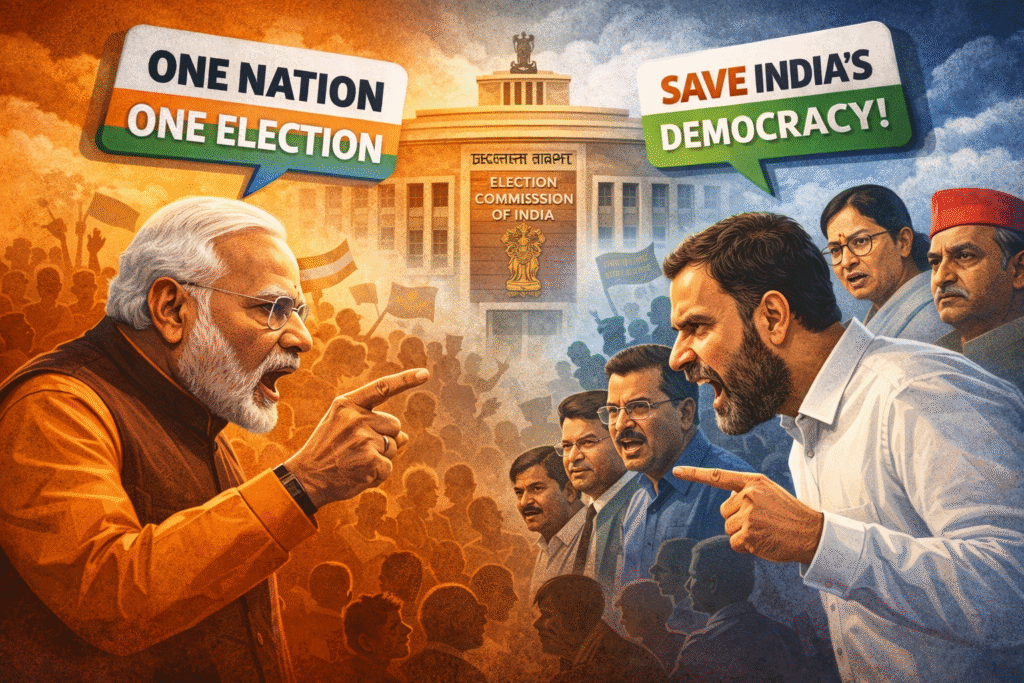
Instead of supporting or opposing blindly, a balanced approach is ideal.
A candidate may suggest:
- Implementing the idea in phases
- Synchronising elections of select states first
- Strengthening constitutional safeguards
- Ensuring federal balance through institutional mechanisms
- Conducting pilot projects before nationwide rollout
🎯 SSB Reality:
Assessors value solutions, not slogans.
🗣️ How to Speak on This Topic in Extempore (60–90 Seconds)
If you receive this topic in extempore, follow a simple and logical flow:
- Brief meaning of the concept
- Why it is being discussed today
- One major advantage
- One major concern
- Balanced conclusion
Sample Flow (Outline Only):
“One Nation One Election refers to conducting Lok Sabha and State elections together.
It is being discussed due to frequent elections affecting governance and increasing costs.
A key advantage is improved administrative efficiency and policy continuity.
However, concerns related to federalism and constitutional challenges remain.
In my opinion, a phased and well-regulated approach can help balance efficiency with democratic values.”
Speak calmly and naturally—avoid rushing or memorised lines.
👥 Group Discussion & Interview Pointers
In Group Discussion:
- Avoid aggressive entry
- Build upon previous speakers
- Use balanced phrases like:
- “I partially agree and would like to add…”
- “Another perspective we can consider is…”
- Avoid naming political parties
In Interview:
You may be asked:
- “Is this suitable for a diverse country like India?”
- “What if a state government collapses?”
- “Will it affect regional parties?”
Answer with:
- Logic
- Calm tone
- Acceptance of complexity
🎖️ Officer’s Lens: How an Armed Forces Officer Should View This

An officer is trained to:
- Think institutionally
- Balance efficiency with ethics
- Respect constitutional values
From this perspective:
- Administrative efficiency is important
- Political stability is desirable
- But democratic safeguards must never be compromised
This reflects qualities like responsibility, maturity, and integrity—core Officer Like Qualities (OLQs).
🧠 Final Takeaway for SSB Aspirants
You are not preparing to win a debate.
You are preparing to demonstrate:
- Awareness
- Balanced judgement
- Clear thinking
- Leadership temperament
If you can speak on this topic without bias, fear, or emotion, you are already ahead of most candidates.
✍️ Self-Practice Task (Highly Recommended)
- Speak on this topic for 90 seconds
- Record yourself
- Evaluate:
- Clarity of ideas
- Speed of speech
- Balance of opinion
This is real SSB preparation—not mugging up GK.
Want to learn more? Try our 03-month course eBook “OLQ by SSB Champions.com” @ INR 499 /- only.