
Table of Contents
🎯 Introduction – The Biggest Myth About GD in SSB
One of the most common misconceptions among SSB aspirants is:
“The more you speak in GD, the better your chances of recommendation.”
Because of this belief, many candidates:
- Try to dominate discussions
- Interrupt others repeatedly
- Speak aggressively
- Force their opinions constantly
Ironically, these are often the same candidates who get rejected.
In reality:
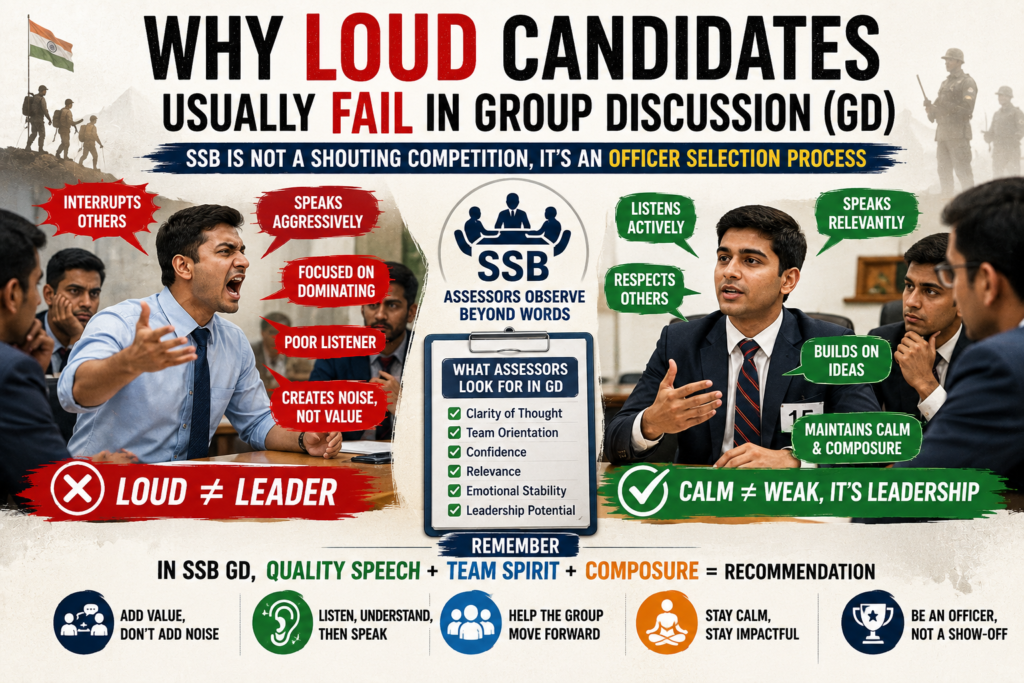
SSB Group Discussion is NOT a shouting competition.
The assessors are not searching for:
- The loudest speaker
- The most aggressive debater
- The person who talks continuously
They are observing:
- Officer Like Qualities (OLQs)
- Team behaviour
- Clarity of thought
- Social effectiveness
- Leadership under group pressure
This article will explain:
- Why loud candidates often fail in GD
- What assessors actually observe
- How recommended candidates behave differently
- How you should approach GD to stand out naturally
📘 What Is Group Discussion in SSB Actually Designed For?
Many aspirants misunderstand the purpose of GD.
GD is not conducted to test:
- English fluency alone
- General knowledge alone
- Debate skills alone
It is designed to assess:
- Thinking ability
- Group behaviour
- Listening skills
- Confidence under pressure
- Leadership qualities
- Social adaptability
The military works through:
- Coordination
- Team functioning
- Mutual trust
Therefore, assessors observe:
“Can this candidate function effectively in a group?”
🚨 Why Loud Candidates Usually Perform Poorly
Now let’s understand the real issue.
Being loud is not the same as being effective.
1️⃣ Loudness Creates Noise, Not Leadership
Many candidates think:
- Speaking continuously = leadership
But leadership is not about dominating people.
In SSB GD:
- Constant interruption creates chaos
- Aggression weakens discussion quality
- Forced speaking reflects insecurity
A true leader:
- Brings structure
- Encourages clarity
- Improves group direction
🔍 SSB Insight:
Officers lead teams.
They do not overpower teammates unnecessarily.
2️⃣ Assessors Observe Listening Skills Carefully
One of the most ignored OLQs is:
Social adaptability
A candidate who:
- Never listens
- Cuts others repeatedly
- Ignores group flow
appears:
- Impatient
- Egoistic
- Insecure
In armed forces, listening is critical because:
- Orders matter
- Coordination matters
- Situational awareness matters
A good GD performer listens actively before speaking.
3️⃣ Aggressive Candidates Often Lose Content Quality
When candidates focus too much on speaking quantity:
- Their structure breaks down
- Points become repetitive
- Logic weakens
- Emotional reactions increase
Assessors prefer:
- Clarity over speed
- Quality over quantity
One meaningful point delivered calmly is more impactful than:
Five aggressive interruptions.
4️⃣ Loud Behaviour Reflects Lack of Emotional Control
Military leadership requires:
- Emotional stability
- Calmness under pressure
- Controlled confidence
Candidates who become hyper-aggressive in GD often reveal:
- Anxiety
- Poor impulse control
- Need for validation
An officer must remain composed even in stressful environments.
🔍 SSB Insight:
GTOs deliberately create noisy GD environments to observe emotional reactions.
5️⃣ Recommended Candidates Usually Influence Silently
This is one of the biggest realities of SSB.
Recommended candidates are often not:
- The loudest
- The funniest
- The most dominant
Instead, they are usually:
- Calm
- Structured
- Relevant
- Timely contributors
They influence the discussion naturally through:
- Good points
- Logical direction
- Group coordination
True leadership creates influence without forcing attention.
👨✈️ What Assessors Actually Observe in GD
Most candidates focus only on:
“How much should I speak?”
But assessors observe much deeper qualities.
✅ 1. Clarity of Thought
Can you:
- Think logically?
- Organise ideas quickly?
- Speak meaningfully?
✅ 2. Team Orientation
Do you:
- Allow others to speak?
- Build on others’ points?
- Maintain group harmony?
✅ 3. Confidence Without Aggression
Can you:
- Speak firmly
- Without becoming hostile?
✅ 4. Awareness & Relevance
Are your points:
- Relevant?
- Structured?
- Connected to the topic?
✅ 5. Emotional Stability
How do you behave when:
- Interrupted?
- Ignored?
- Challenged?
This is extremely important.
⚖️ Does This Mean You Should Speak Less?
Absolutely not.
This is another dangerous misunderstanding.
Silent candidates also usually perform poorly because:
- Participation matters
- Initiative matters
- Confidence matters
The ideal GD candidate:
- Speaks sufficiently
- Speaks meaningfully
- Speaks calmly
- Speaks at the right moments
🎯 The goal is:
Balanced participation.
Master Your OLQs (Special Offer)
Success in GTO is 100% dependent on your Officer-Like Qualities. If you want to internalize these traits naturally, my Ebook “OLQs – How to Prepare for OLQs Without Coaching” provides the exact roadmap used by recommended candidates.
Grab your copy today for just Rs. 499/- and start your journey toward the uniform. Buy Now.
🧠 How Recommended Candidates Usually Behave in GD
Let’s understand practical behaviour patterns.
✅ They Enter Calmly
No desperation.
No panic speaking.
✅ They Focus on Content
They think before speaking.
✅ They Listen Properly
Good candidates absorb group flow.
✅ They Build Discussions
Instead of fighting unnecessarily, they:
- Connect ideas
- Add structure
- Move discussion forward
✅ They Stay Emotionally Stable
Even in chaotic GDs, they remain composed.
🔍 SSB Insight:
Calmness under pressure is a strong officer trait.
🚫 Common Mistakes Candidates Make in GD
❌ Interrupting Constantly
This damages group quality.
❌ Speaking Without Structure
Random points reduce impact.
❌ Becoming Emotional
Aggression weakens officer-like impression.
❌ Treating GD Like a Debate Competition
SSB GD is cooperative evaluation—not TV debate culture.
❌ Memorising Fancy Lines
Artificial communication becomes obvious quickly.
🗣️ Practical Formula for Performing Well in GD
Here’s a simple approach:
STEP 1: Enter Early If Possible
One good early point helps visibility.
STEP 2: Stay Relevant
Do not force unrelated facts.
STEP 3: Speak 3–5 Quality Times
This is usually enough if your content is meaningful.
STEP 4: Maintain Calm Body Language
- Relaxed posture
- Controlled expressions
- Stable voice tone
STEP 5: Help Group Flow
This creates leadership impression naturally.
Example:
“Let’s also look at the economic perspective.”
Very officer-like behaviour.
🎖️ Officer’s Lens – Why GD Behaviour Matters in Armed Forces
In military environments:
- Coordination saves lives
- Communication affects operations
- Emotional stability influences teams
An officer who:
- Shouts unnecessarily
- Ignores teammates
- Loses composure under pressure
can damage unit effectiveness.
That is why SSB GD evaluates:
Your behaviour under social pressure.
Not just your speaking ability.
🧠 Final Takeaway for SSB Aspirants
The loudest candidate is rarely the best GD performer.
SSB assessors are searching for:
- Calm confidence
- Team orientation
- Logical thinking
- Emotional maturity
- Balanced leadership
Remember:
Influence is more powerful than noise.
If you can:
- Speak calmly
- Think clearly
- Participate naturally
- Maintain composure
—you already appear more officer-like than most candidates.
✍️ Self-Practice Task
During your next GD practice:
- Focus more on listening
- Speak only when adding value
- Observe your emotional reactions
Ask yourself:
“Am I trying to contribute… or trying to dominate?”
That difference changes your entire GD performance.
Master Your OLQs (Special Offer)
Success in GTO is 100% dependent on your Officer-Like Qualities. If you want to internalize these traits naturally, my Ebook “OLQs – How to Prepare for OLQs Without Coaching” provides the exact roadmap used by recommended candidates.
Grab your copy today for just Rs. 499/- and start your journey toward the uniform. Buy Now.