
Table of Contents
“Cyber Warfare & National Security” is a modern warfare topic that is increasingly relevant in:
- Extempore
- Group Discussion
- Personal Interview
Many candidates struggle here because they:
- Think cyber warfare is too technical
- Give vague answers like “hacking and security”
- Fail to connect it with real-world defence
In SSB, assessors are not testing technical expertise. They are observing:
- Awareness of modern threats
- Ability to simplify complex ideas
- Strategic thinking
- Calm and logical expression
This topic helps you show future readiness, which is a key officer trait.
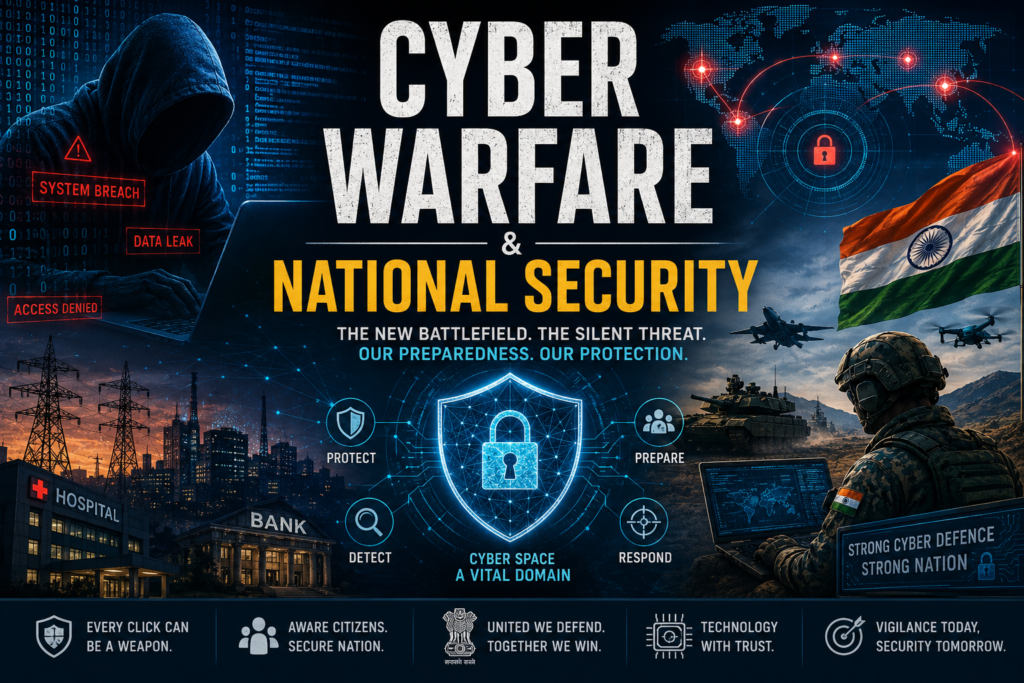
📘 What Is Cyber Warfare?
Cyber warfare refers to the use of digital attacks by one nation to disrupt, damage, or gain control over another nation’s systems.
In simple terms:
It is war fought through computers, networks, and data, instead of traditional weapons.
Targets in Cyber Warfare:
- Military systems
- Power grids
- Banking networks
- Communication systems
- Government databases
Unlike traditional war, cyber warfare can happen:
- Without physical borders
- Without immediate detection
- Without direct military engagement
⏳ Why Is Cyber Warfare Important Today?
Modern nations are becoming highly dependent on digital systems.
Key Reasons:
1. Digital Dependency
- Banking, defence, communication—all rely on networks
- Disruption can paralyse a country
2. Invisible Nature of Attacks
- No tanks or missiles required
- Attacks can be carried out remotely
3. Low Cost, High Impact
- Cheaper than traditional warfare
- Can cause massive damage
4. Rise of Hybrid Warfare
- Combination of cyber + psychological + information warfare
- Used to weaken a nation internally
🔍 SSB Insight:
This topic reflects understanding of modern battlefield, not just traditional war.
✅ Advantages (From a Strategic Perspective)
Even though cyber warfare is a threat, understanding its strengths is important.
1. Non-Physical Engagement
- No direct loss of soldiers’ lives
- Reduces human casualties
2. Strategic Advantage
- Can weaken enemy systems before actual conflict
- Provides intelligence advantage
3. Cost Efficiency
- Requires fewer resources compared to traditional war
4. Speed and Reach
- Attacks can happen instantly across borders
📝 SSB Tip:
Always clarify that these are strategic aspects, not something to promote.
❌ Challenges and Threats
This is the most important part for SSB.
1. Threat to Critical Infrastructure
- Power grids, hospitals, transport systems can be targeted
- Can disrupt daily life
2. Cyber Terrorism
- Non-state actors can also carry out attacks
- Hard to trace
3. Data Breaches and Espionage
- Sensitive military and government data can be stolen
4. Difficulty in Attribution
- Hard to identify the attacker
- Makes retaliation complex
5. Impact on Civilian Life
- Cyber attacks affect common citizens directly
🔍 SSB Insight:
An officer must think about civilian safety, not just military advantage.
⚖️ A Balanced Approach
Instead of fear or overconfidence, a practical approach is needed.
Key Measures:
- Strengthening cyber security infrastructure
- Developing indigenous technology
- Training cyber warfare specialists
- Promoting awareness among citizens
- International cooperation for cyber norms
🎯 SSB Reality:
A good officer focuses on preparedness and prevention, not panic.
🗣️ How to Speak on This Topic in Extempore (60–90 Seconds)
Use a simple structure:
- Define cyber warfare
- Explain why it is important today
- Mention one key threat
- Suggest a solution
- Conclude positively
Sample Flow (Outline):
“Cyber warfare refers to digital attacks carried out by nations to disrupt systems of another country.
It has become important due to increasing digital dependency in sectors like banking, defence, and communication.
A major threat is the targeting of critical infrastructure like power grids.
To counter this, nations must strengthen cyber security and develop skilled manpower.
In my opinion, cyber preparedness is as important as traditional military strength today.”
👥 Group Discussion & Interview Pointers
In Group Discussion:
- Keep your language simple
- Avoid technical overload
- Connect cyber warfare with real-life impact
Useful phrases:
- “From a national security perspective…”
- “Another important aspect is…”
In Interview:
You may be asked:
- “Can cyber warfare replace traditional warfare?”
- “Is India prepared for cyber threats?”
- “What role can youth play in cyber security?”
Answer with:
- Balanced thinking
- Practical examples
- Calm delivery
🎖️ Officer’s Lens: How an Armed Forces Officer Should View This
An officer must:
- Understand evolving threats
- Adapt to new technologies
- Protect both military and civilian systems
From this perspective:
- Cyber warfare is a real and growing threat
- Preparedness is essential
- Human judgement remains critical
An officer is not just a fighter but also a protector of national systems.
🧠 Final Takeaway for SSB Aspirants
Cyber warfare is not just about technology—it is about national resilience.
You are expected to show:
- Awareness of modern challenges
- Calm and logical thinking
- Ability to adapt to change
- Responsibility towards society
If you can explain this topic in a simple, structured, and balanced way, you demonstrate strong officer potential.
✍️ Self-Practice Task
- Speak on this topic for 90 seconds
- Record yourself
- Evaluate:
- Clarity
- Simplicity
- Confidence
Remember:
SSB is not about how much you know, but how clearly you think and express.
Master Your OLQs (Special Offer)
Success in GTO is 100% dependent on your Officer-Like Qualities. If you want to internalize these traits naturally, my Ebook “OLQs – How to Prepare for OLQs Without Coaching” provides the exact roadmap used by recommended candidates.
Grab your copy today for just Rs. 499/- and start your journey toward the uniform. Buy Now.